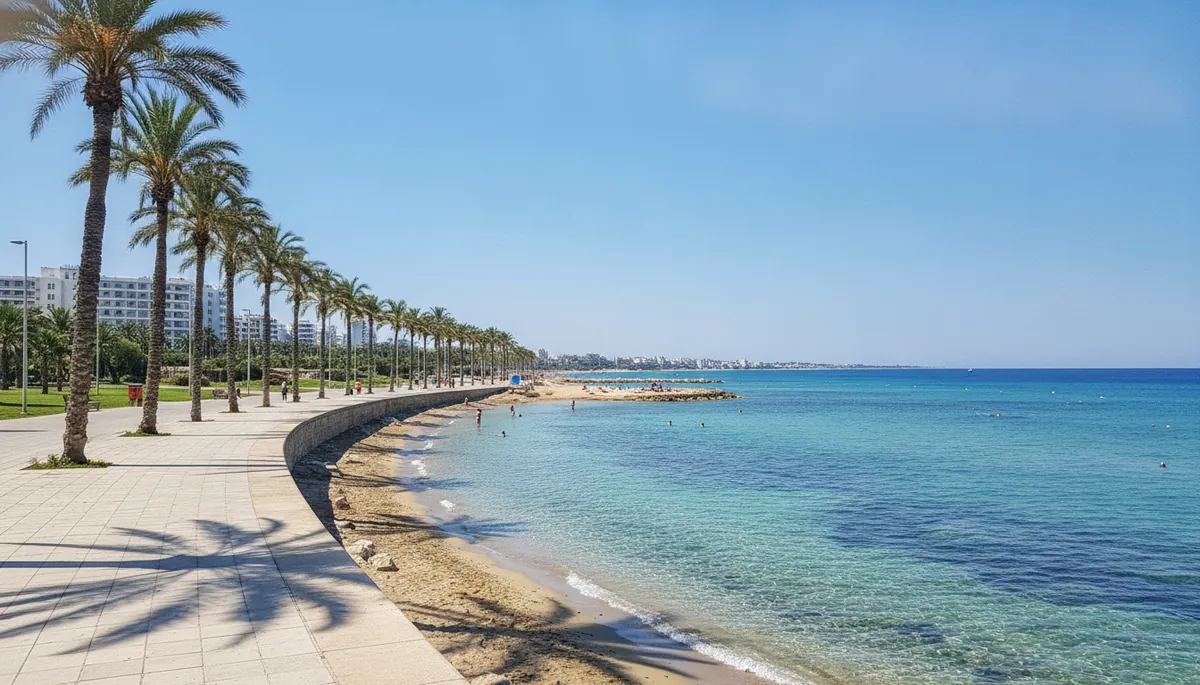
Cyprus is an under-the-radar alternative to Malta: EU standards, warm climate and lower prices. It’s an affordable European destination for learning English, but it comes with its own cultural nuances that can affect your language immersion. This guide covers costs, who it suits, and how it compares with other destinations.
What does it cost to study English in Cyprus?
Tuition in Cyprus typically runs about €150-220 per week, which is 15-25% cheaper than Malta. Living costs are also lower than most Western European countries. A realistic monthly budget for a student would be:
- Accommodation (homestay or shared apartment): €300-500 per month
- Food (cooking at home): €200-300 per month
- Transport (bus passes): €30-50 per month
- Miscellaneous (social, phone, etc.): €100-200 per month
So, overall you might spend €800-1,200 per month including tuition. Compare this to Malta, where similar costs often exceed €1,500. However, for truly all-inclusive value at $900-1,400 per month (tuition, private room, three meals daily), you might consider the Philippines. Many schools there include 4-8 one-to-one lessons daily, which gives you far more speaking practice than group classes in Cyprus. See our guide on English in the Philippines to understand immersion specifics.
Where are the English schools in Cyprus?
Most schools cluster in two main cities:
- Limassol - The coastal hub, with the largest concentration of schools and a big expat community.
- Larnaca - A quieter option, close to the airport, with cheaper living costs than Limassol.
- Nicosia - The capital, more inland and split between Greek and Turkish zones. Good for culture, less for beach lifestyle.
Most students prefer Limassol for its nightlife and seaside, but Larnaca offers similar standards at slightly lower prices. Nicosia has fewer schools but a more authentic local feel.
What is the student lifestyle like?
Cyprus is an island of sun, sea, and ancient history. Outside class, you can hike the Troodos Mountains, visit archaeological sites like Kourion, or simply enjoy the Mediterranean beaches. The pace of life is relaxed, with a strong cafe culture. However, the local language is Greek, and while English is widely spoken in tourist areas, you’ll need to be proactive about practising outside class. In Limassol, you’ll find a large Russian-speaking community, which some learners find reassuring for settling in - though it does mean you might be tempted to speak Russian more than English. This is a double-edged sword: it’s easier to make friends, but it can slow your progress. If you want true total immersion, the Philippines offers a different experience. With 23 schools across Cebu, Mactan, Baguio, and Clark, you’ll be surrounded by English speakers daily, and classes are one-to-one. Check out our best schools in the Philippines for comparison.
Is Cyprus a good place for a beginner?
Cyprus is suitable for beginners, but classes are often group-based (10-12 students), so you get less individual attention. For absolute beginners, small group classes might be less effective. The Philippines, by contrast, offers 4-8 one-to-one lessons per day, which is ideal for rapid progress. Beginners frequently see significant gains in a short time because every lesson is tailored to their needs.
Who should choose Cyprus?
Cyprus is a excellent choice if you:
- Want to learn in Europe without breaking the bank.
- Prefer a warm climate and scenic surroundings.
- Are at an intermediate level or above, where group classes are less critical.
- Need a Schengen visa or want to stay within the EU.
- Enjoy a relaxed, multicultural environment.
If you’re a total beginner or really want to maximise speaking practice per euro spent, you might want to compare with the Philippines. The all-in price of $900-1,400 per month covers everything, and you get intensive one-to-one teaching. You’ll also avoid the visa hassles - for language courses under 59 days, you don’t need a 9(f) student visa; the school arranges an SSP for $100-200, and an ACR I-Card costs just $50-70 later. This makes logistics simple.
How does Cyprus compare with Malta?
Malta is the more famous English-learning destination in the Mediterranean. Cyprus is cheaper by 15-25% on tuition and offers a less commercialised experience. However, Malta is a fully English-speaking country (with its own dialect), which gives better out-of-class immersion. In Cyprus, English is an official language but not the primary one you’ll hear on the streets. If your goal is maximum practice with locals, Malta wins. If you want to save money and are comfortable with a bit less immersion, Cyprus is solid.
How does it compare with the Philippines?
This is an apples-to-oranges comparison. Cyprus offers a European lifestyle and proximity to other Schengen countries for weekend trips. The Philippines offers an intensive, all-inclusive study experience at a lower absolute cost. In Cyprus, you might pay €150-220 per week just for tuition; in the Philippines, your entire package - tuition, private room, three meals daily - costs about $900-1,400 per month, which is roughly $31 per day. That works out to around €1,000 per month, inclusive. You get 4-8 one-to-one lessons daily, versus perhaps 20 hours of group classes. For efficient learning, the Philippines wins. For cultural curiosity and European travel, Cyprus is attractive. Ultimately, it depends on your priorities. Our cost guide for the Philippines gives more detail on pricing and what you get for your money.
What are the visa requirements for Cyprus?
For EU/EEA citizens, no visa is needed. For others, you can enter as a tourist for up to 90 days and study part-time, but if your course is longer, you’ll need a student visa. Cyprus issues a student visa for courses longer than 90 days, and processes are managed by the schools. This is more straightforward than in many other countries, but you’ll still need to provide proof of funds and accommodation. The Philippines simplifies this further: no student visa needed for short language courses; you get an SSP (study permit) for about $100-200, arranged by the school, and an ACR I-Card for $50-70 after about 59 days.
Which is better for you: Cyprus or the Philippines?
You have to think about what kind of experience you want. Cyprus is a short hop from Europe, with a beach holiday vibe and modern amenities. The Philippines is a developing nation in Asia, with a bustling energy, and an education system that specifically excels at teaching English as a second language. If you’re an independent, mid-level learner who enjoys exploring Europe and can manage your own study schedule, Cyprus might be your pick. If you want the fastest progress possible in a structured, all-inclusive environment, the Philippines is hard to beat. There, you’re living on campus, eating three meals a day, and having one-to-one classes with teachers who are experienced in teaching Asian students - that tailored approach can make a huge difference.
Still comparing schools alone is hard. At philippinesschool.study, we offer a free matching service for students. Our consultant Julia has visited all the campuses in person, and she can walk you through enrolment and explain how the SSP is arranged for you. You pay exactly the school’s own price - no mark-up, ever. If you’re considering the Philippines, we can help you choose the best school from the 23 across Cebu, Mactan, Baguio, and Clark. If you’re still torn between Cyprus and the Philippines, we can give you honest advice on what fits your budget and goals. Comparing schools alone is hard, but matching is free for the student, and prices are the school’s own with no mark-up, because Julia visited the campuses in person, and she can walk you through enrolment and explain how the SSP is arranged. Get a free, no-mark-up school match and see if the Philippines could be the perfect fit for your English journey.